
Your child eats. They sleep. They go to school. And yet something feels slightly off, they tire quickly, seem distracted, catch every cold that passes through class, or complain of headaches you can't explain. Iron deficiency is one of the most common and most commonly missed reasons why.
India carries the world's highest burden of childhood anemia. According to NFHS-5 (2019–21), 67.1% of children under five in India are anaemic and the problem doesn't disappear at school age. Roughly 40% of children aged 5-12 remain iron-deficient. That's not a rare medical condition. That's the statistical norm for Indian children.
The harder truth is that iron deficiency rarely looks dramatic. It doesn't announce itself. It quietly chips away at energy, focus, immunity, and growth, often for months or years before a blood test confirms it. This article explains what's happening, why Indian children are disproportionately affected, and what parents can do right now through food.
What Iron Actually Does in a Child's Body
Most parents know iron is "important." Fewer know exactly what breaks down when it's missing.
1. Oxygen transport
Iron is the core component of haemoglobin, the protein in red blood cells that carries oxygen from the lungs to every cell in the body. When iron is low, haemoglobin production falls, fewer red blood cells are made, and every organ, including the brain receives less oxygen. This is clinical anemia.
2. Brain development and cognitive function
This is the consequence that concerns paediatric researchers most. The brain develops most rapidly between ages 0–5, but the hippocampus, the brain's memory and learning centre, remains highly iron-dependent until at least age 12. Iron is required for the production of myelin, the insulating sheath around nerve fibres that determines how fast signals travel between neurons.
A landmark 2019 study in the Lancet Global Health followed 1,200 children from birth to age 10 and found that children who experienced iron deficiency between ages 1–3 scored measurably lower on tests of language, memory, and fine motor skills at age 10 even after their iron levels were later corrected. The window of deficiency mattered more than the eventual correction.
3. Immune function
Iron is required for the proliferation of lymphocytes, the white blood cells that are the backbone of immune response. Iron-deficient children don't just feel tired more often; they genuinely have a compromised immune system. Studies consistently show higher rates of respiratory infections, diarrhoeal illness, and slower recovery in iron-deficient children compared to iron-sufficient peers.
4. Physical growth and stamina
Iron is essential for muscle metabolism, it is a component of myoglobin, the oxygen-storing protein in muscle tissue. Children with iron deficiency fatigue faster during physical activity, show lower exercise tolerance, and in chronic cases, demonstrate reduced height and weight gain compared to iron-sufficient peers of the same age.
Key stat: A child with iron deficiency anemia has approximately 50% lower work capacity during physical activity than an iron-sufficient child of the same age and body weight. This shows up as the child who always sits out PE, falls asleep on the way home from school, or refuses to play after dinner.
Warning Signs to Watch For
-
Persistent fatigue and low energy
-
Pale inner eyelids, lips, or nail beds
-
Frequent infections or slow recovery
-
Difficulty concentrating and short attention span
-
Unusual food cravings
-
Headaches and dizziness
-
Brittle, spoon-shaped nails
-
Restless leg syndrome at night
How Much Iron Does Your Child Actually Need?
ICMR's recommended daily allowances for iron are higher for Indian children than WHO global averages, specifically because Indian diets are predominantly plant-based, which means lower iron bioavailability must be factored in:
|
Age group |
ICMR daily requirement |
Why it rises |
|
1–3 years |
9 mg/day |
Rapid growth; brain development peak |
|
4–6 years |
13 mg/day |
Cognitive development; school readiness |
|
7–9 years |
16 mg/day |
Physical activity increases; stores deplete faster |
|
10–12 years (boys) |
21 mg/day |
Pre-pubescent growth spurt |
|
10–12 years (girls) |
27 mg/day |
Onset of menstruation increases demand sharply |
The Best Iron-Rich Indian Foods for Children
The good news: Indian cuisine contains many excellent iron sources. The challenge is consistency and knowing which combinations actually deliver usable iron to the body:
|
Iron-rich Indian food |
Serving |
Iron per serving |
Smart use tip |
|
Halim (garden cress) seeds |
100 g |
~100 mg |
Mix into roti dough or ladoos, traditional and highly potent |
|
Dates (khajoor) |
100 g |
~1.0 mg |
Natural, whole-food iron + fibre; ideal daily snack base |
|
Cashews |
30 g |
~2.0 mg |
Snack or add to dal and sabzi; also provides copper for absorption |
|
Rajma (kidney beans) |
1 cup |
~5.2 mg |
Pair with Vitamin C (tomato, amla) to boost non-haem absorption |
|
Spinach (palak) |
1 cup |
~3.6 mg |
Cooked; pair with lemon juice, Vitamin C triples absorption |
|
Whole moong / masoor dal |
1 cup |
~3.3 mg |
Daily staple - easy, consistent, well-tolerated by children |
|
Ragi (finger millet) |
100 g |
~3.9 mg |
Also provides calcium; use in porridge, ladoos, or roti |
|
Bajra (pearl millet) |
100 g |
~8.0 mg |
Highest iron of common Indian grains; use in roti or khichdi |
|
Peanuts / peanut butter |
2 tbsp |
~0.6 mg |
Easy tiffin addition; also provides protein to support haemoglobin |
|
Jaggery (gud) |
1 tbsp |
~0.5 mg |
Traditional iron source; use instead of refined sugar where possible |
The Absorption Problem : This Is Where Most Parents Lose Iron
|
Iron absorption boosters |
Iron absorption blockers |
|
Vitamin C - amla, tomato, lemon, guava eaten at the same meal |
Tea or chai within 1 hour of a meal (tannins block absorption by up to 60%) |
|
Cooking in iron kadhai (leaches trace iron into food) |
Calcium-rich foods at the exact same time (milk with dal reduces iron uptake) |
|
Fermented foods - idli, dosa batter (reduces phytates) |
Phytates in unsoaked whole grains and legumes |
|
Soaking and sprouting lentils before cooking |
Excess zinc supplementation competes with iron absorption |
|
Vitamin A - carrots, sweet potato, mango (enhances absorption) |
Packaged foods with EDTA preservatives (chelates iron in the gut) |
What Snack Choices Have to Do With Iron
The average Indian school child eats 1–2 snacks per day outside main meals. Over a year, that's 365-730 snack occasions - each one either contributing to or detracting from daily iron intake.
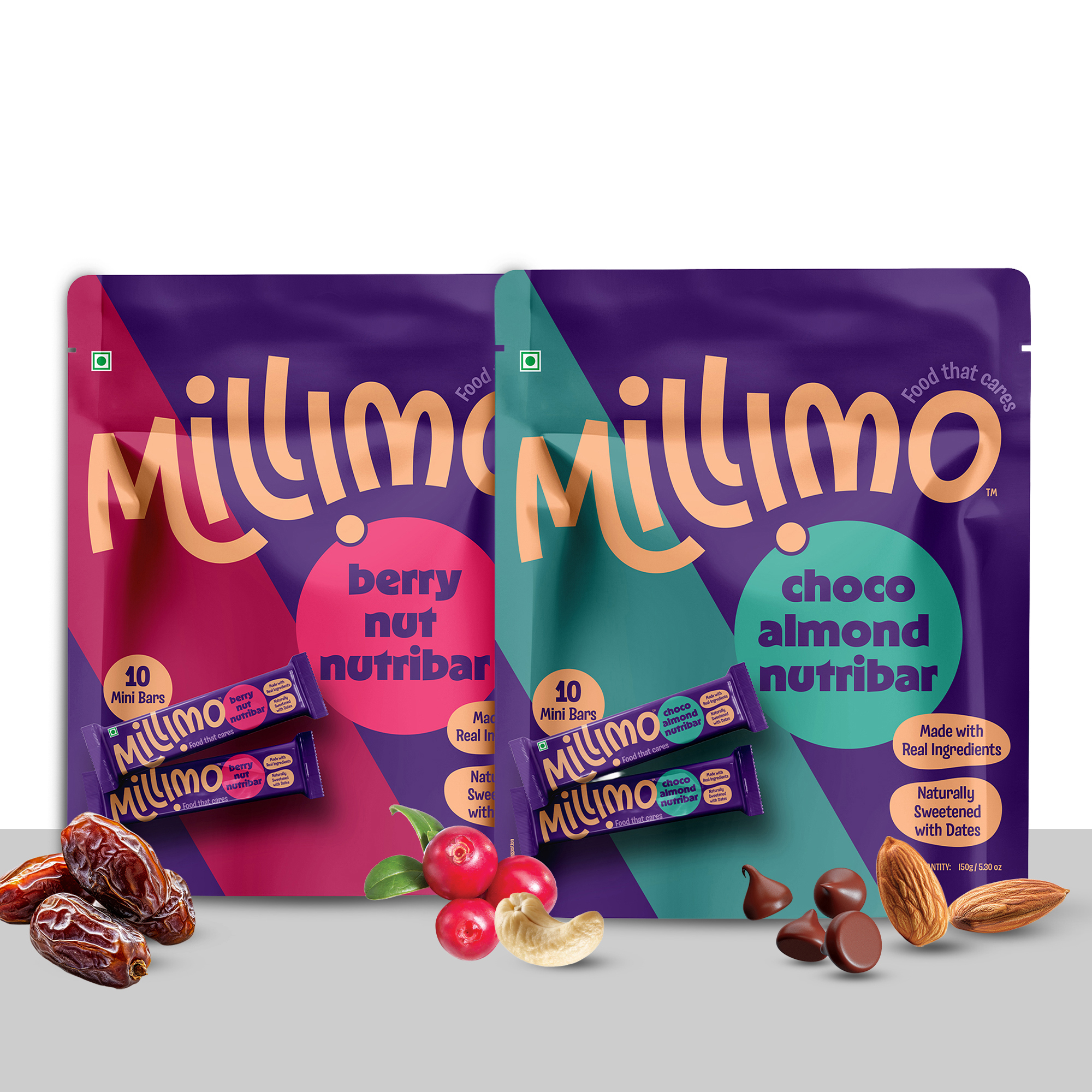
Millimo Nutribars are built around ingredients that genuinely contribute to iron intake: dates (~1 mg iron per 100 g with natural sugars that don't inhibit absorption), cashews (~6.7 mg iron per 100 g, one of the highest among common snack ingredients), and cranberries (which provide Vitamin C to enhance non-haem iron absorption from other foods eaten around the same time).
It's not a supplement. It's a snack that does nutritional work quietly, consistently, at the snack occasions that add up across a child's entire school year.
Quick Answers
Can iron deficiency be fixed with diet alone, or does my child need supplements?
Mild to moderate iron deficiency in children without clinical anaemia can often be corrected through consistent dietary improvement over 3–6 months. Clinical anaemia — confirmed by blood test with low haemoglobin and low ferritin — typically requires iron supplementation prescribed by a paediatrician alongside dietary changes. Do not give iron supplements without a blood test — excess iron is harmful.
My child eats spinach regularly. Why might they still be iron-deficient?
Spinach contains oxalates that bind iron and significantly reduce absorption. The actual usable iron from spinach is much lower than the raw mg figure suggests. Cooking spinach, pairing it with lemon juice or tomato, and not drinking chai within an hour of eating it substantially improves absorption. Variety across iron sources matters more than relying on any single food.
Is jaggery a good iron source for children?
Jaggery contains more iron than refined sugar (~11 mg/100 g for dark jaggery, though highly variable by source), but the quantities consumed in daily cooking are small. It is a meaningful supplementary source and far better than refined sugar, but should not be relied upon as a primary iron source. Pair it with iron-rich foods rather than treating it as sufficient on its own.
Does cow's milk cause iron deficiency?
Excess cow's milk - particularly more than 500 ml per day in children over 1 year is a well-documented risk factor for iron deficiency. Milk is low in iron, high in calcium (which competes for absorption), and can displace iron-rich foods from the diet. Milk is valuable for calcium and protein but should not dominate a child's diet to the exclusion of iron-containing foods.